

Product engineering
Digital product development that starts with the right first release
We help founders and product teams decide what to build first, prove it with real users, and ship a version that can grow.

Overview
Shape an idea into a first release worth building, then keep shipping.
Most new products do not fail on code. They fail because the first release tries to do too much, or the wrong thing, and the budget runs out before anyone learns what users actually need. We start by narrowing the problem, testing the riskiest assumption cheaply, and only then writing production code. You get a release plan with a reason behind every feature, and an architecture that will not need rebuilding when the second release arrives.
What is included
- Product discovery workshop
- Problem and user research summary
- Prioritised feature map
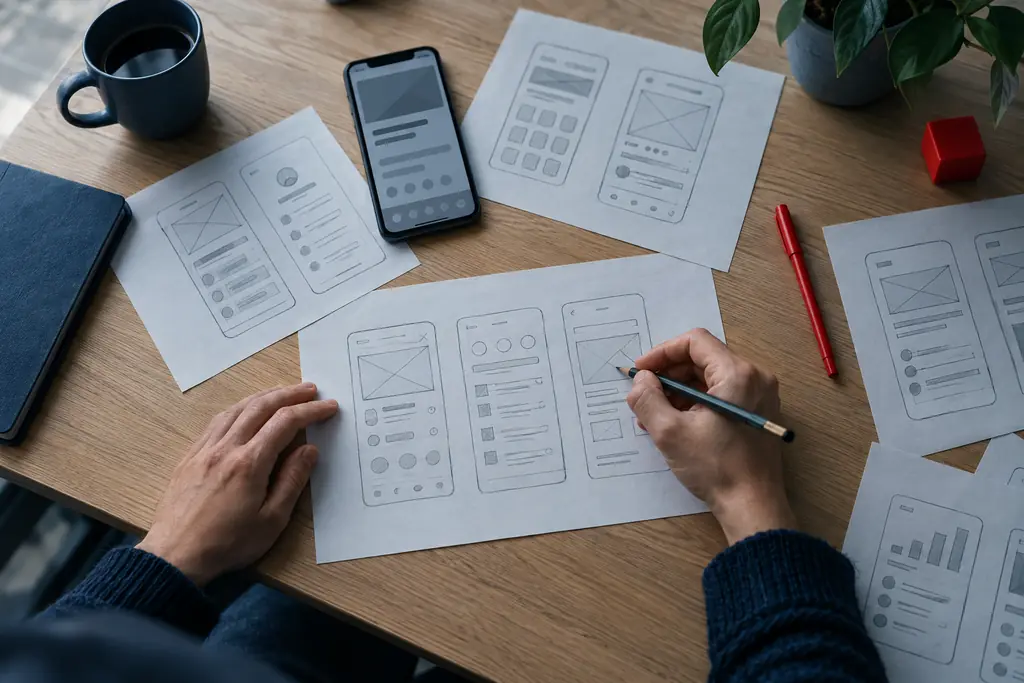
- Clickable prototype
- Technical architecture note
- MVP build, test and launch
What you can expect
A first release with a reason for every feature
Scope is tied to one measurable goal, so the team knows what to cut when time or money gets tight.
Evidence before expensive build work
Clickable prototypes go in front of real users early, while changes still cost hours rather than sprints.
An architecture that survives release two
We pick boring, well-supported technology and leave room for the features you already know are coming.
A team that can carry it forward
Documentation, environments and handover notes are part of the work, whether we stay on or your team takes over.
How a product development project runs
The same four-stage rhythm we use on every engagement, tuned for this kind of work.
Frame
Agree the problem, the user and the one result the first release must achieve.
Prove
Prototype the riskiest part and test it with five to eight real users.
Build
Ship in two-week cycles with a working demo at the end of each one.
Launch and learn
Release, measure against the goal, and plan the next increment from data.
Tools and platforms we use
- React
- Next.js
- Flutter
- Node.js
- Laravel
- PostgreSQL
- AWS
- Figma
Product development questions
What people usually ask before starting a product development project.
What is an MVP and how small should it be?
An MVP is the smallest release that lets real users complete the core task and gives you evidence about whether the product works. It should be small enough to ship in weeks, not quarters. We usually cut the first scope by a third during discovery by separating what users need on day one from what can wait for release two.
Can you start from just an idea?
Yes. Many projects start with a one-page idea or a conversation. Discovery turns that into a defined problem, a target user, a prioritised feature map and a prototype. If the idea needs more validation before building, we will say so and suggest the cheapest way to test it first.
How much does it cost to build a digital product?
Cost depends on the number of user roles, integrations with other systems, platform choices and how much has already been decided. A paid discovery phase gives you a fixed price for that phase and a reliable estimate for the build, based on real scope rather than guesses. We share ranges on the first call once we understand the shape of the work.
How long does it take to launch a first version?
A focused first release typically takes eight to sixteen weeks after discovery, depending on scope and integrations. We plan in two-week cycles, show working software at the end of each one, and keep a visible list of what has been moved to a later release so timelines stay honest.
Who owns the code and intellectual property?
You do. Source code, designs and documentation are assigned to you under the agreement once invoices for that work are paid. Code lives in a repository you control from the start, so there is never a handover dispute or a hostage situation.
What happens after the first release?
You can continue with us on an ongoing product team, move to a smaller support plan, or hand over to your own developers. Each option is planned before launch, with documentation and access transferred so the product does not depend on any one person.

Talk to us about product development
Tell us what you need. We reply within one business day with next steps, questions or a time to talk.